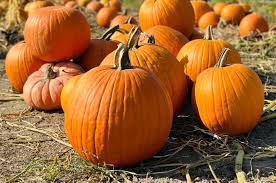
You read the title, and I imagine you might be initially confused at the notion that a pumpkin is a fruit.
Well, I’m here to tell you that all squashes are considered fruits since they contain seeds and develop from the flower-producing part of the plant.
Now that I’ve squashed your confusion, let’s immerse ourselves in the wide world of pumpkins!
Pumpkin: The Word
Believe it or not, “pumpkin” is an American creation!
Earlier forms of English listed a word “pompion” as a branch back to an old Greek word that meant “melon”.
When colonization took place in the United States, settlers encountered these odd gourds that the indigenous people of the region called pôhpukun, which meant “grows forth round” in the Massachusett tongue.
In fact, the word “squash” came from the same area of the Americas, so an entire subspecies of fruits was categorized completely by Indigenous Americans, more specifically the Wampanoag and Narragansett.
Origins
The earliest known recording of pumpkins’ existence dates back to 7,000-5,500 BC in Mexico. Indigenous people in the area adopted the common practice of clustering different crops together to make the most of the available fertile land.
This practice has become known as the Three Sisters where seeds of squash, beans, and corn are all grown together.
Beans will grow up the cornstalk, making the cornstalk more stable to withstand strong winds while the squash’s wide leaves allow the soil to stay cooler and covered, fending off nasty weeds.
Pumpkins are often grown from July to deep into the fall with squash bees (in most cases) serving as their most diligent pollinators.
These orange gourds can balloon to a weight of 18 pounds on average, but they can also be as small as 6 pounds. Unless, you’re really going for the gusto, in which case your pumpkins can weight more than a ton!
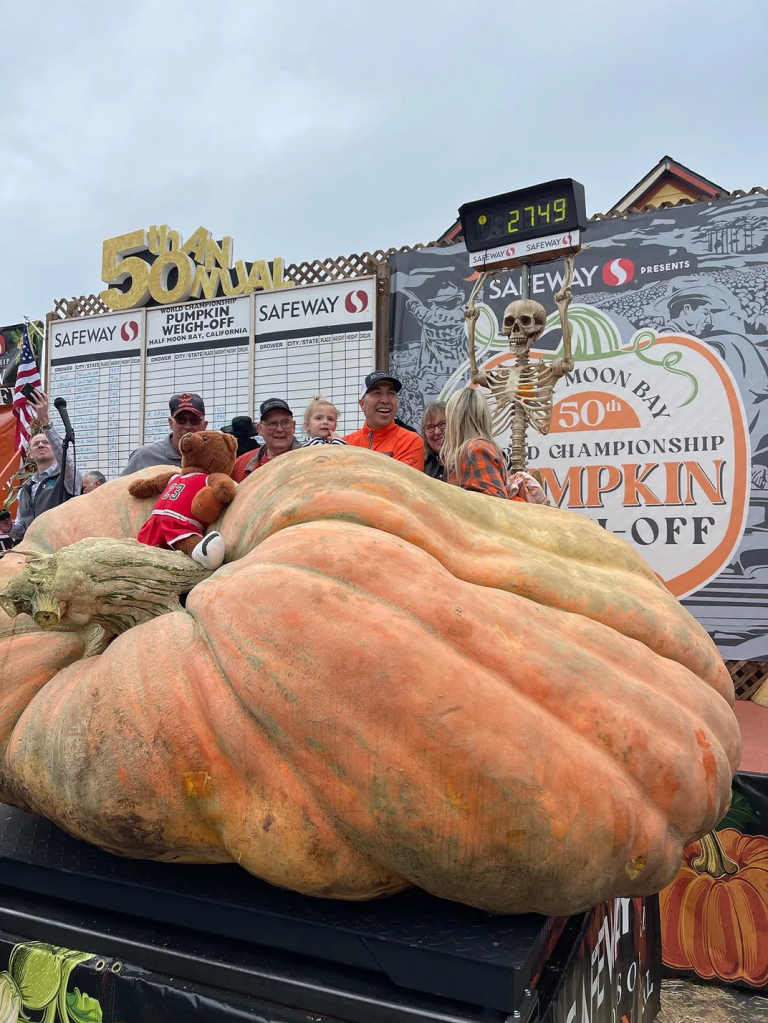
Last year, Minnesota native Travis Gienger showed up to the 2023 World Championship Pumpkin Weigh-Off with his gourd named “Michael Jordan”.
The pumpkin made headlines much like its namesake, tipping the scales at a world-record-breaking 2,749 pounds!
Most pumpkins made for commercial consumption come from Illinois, Indiana, Ohio, Pennsylvania, and California, with Illinois taking the top spot by yielding 41 percent of the country’s pumpkins.
How To Eat Pumpkins
Pumpkins can be eaten in a number of different ways, but most commonly, they are eaten in the form of their seeds (pepitas) or as a pie.
A great source of many essential vitamins and minerals, pepitas can be eaten raw or roasted and serve as a snack for people trying to find protein outside of meat.
Much like its delicious cousin, pumpkin bread, the decadent pumpkin pie rose to prominence over the last few centuries during late-year North American holidays in Canada and the US, namely Thanksgiving.
The flesh of the pumpkin must be pureed and blended with a mixture of eggs, milk/cream, sugar, and spices before setting the mixture in a pie shell to bake.
Best served divided to share and with plenty of whipped cream, pumpkin pie has become my favorite desert dish since I tried it for the first time when I was 7 years old.
As a result, I’ll eat anything pumpkin flavored. Pumpkin spice latte? Yes please! Pumpkin muffin? Absolutely. Pumpkin pie Pop-Tart? You bet!
The cravings for pumpkin continues to swell not just for me, but others as well. How else do you explain the existence of a pumpkin pie Oreo?
But, enough about what’s on the inside. Let’s chat about what to do with the empty husk you have after you’ve removed its innards.
Might I suggest carving a design into it? It sounds crazy, but it’s quite fun!

Known as a jack-O-lantern, people in the United Kingdom had been carving lanterns into turnips and rutabegas for eons before the publishing of the Story of Stingy Jack.
Stingy Jack is a fable about a town drunk that repeatedly outsmarts Satan in his attempts to steal his soul, to the point that — in order to end Jack’s torment — Satan agreed to abandon his soul-stealing expedition.
Unfortunately for Jack, his sinful life led to God denying Jack entry through the Pearly Gates, leaving the drunk to wander aimlessly in the boundary between Good and Evil until the end of time.
I suppose the lanterns are used to keep Stingy Jack’s evil ways from entering your household, almost as a way to scare him.
This could be linked to the folklore of All Hallows’ Eve where it’s said that the dead walk the Earth at night, so the spooky squashes scare away the evil spirits.
Anyhow, American settlers began using pumpkins as lanterns since they were easier to carve considering their larger size compared to yesteryear’s turnips.
Pumpkin chunking competitions also appear in the fall where people build wacky contraptions that send the gourds flying at ridiculous speeds to their untimely deaths many yards away from their launching point.
Conclusion
If you don’t like pumpkin, I can’t help you with this review.
Pumpkins are a versatile fruit that allows for a lot of different edible preparations of its contents, whether that be the leaves that grow on the vine, the seeds within, or the other guts within the rind.
It is by far one of my top-5 favorite fruits (stay tuned for a fruit tierlist), and I don’t think it receives the abundance of praise it deserves.
Vitamin A & C, potassium, antioxidants, protein, fiber (!!), and tryptophan all wrapped into a cute orange package that you can carve into anything you want.
Oh, and you can use the carved husk as mood lighting outside your house to scare away creeps and jerks!
So, the next time you complain about pumpkin spice lattes, remember how awesome and cool pumpkins are as a whole.
Go roast some seeds, eat a pumpkin pie like a medium pizza, and carve a funny face! Enjoy and embrace our glorious gourd!
Grade: A
 The Wide World of Dirt
Leave a comment